“I train. I’m just not going anywhere.”
Not lacking discipline. You've been showing up for months. What's missing is someone who remembers what you lifted in March and changes the plan instead of printing the same one again.
Kelli and Jordan, Co-Founders, AION Sculpts ·
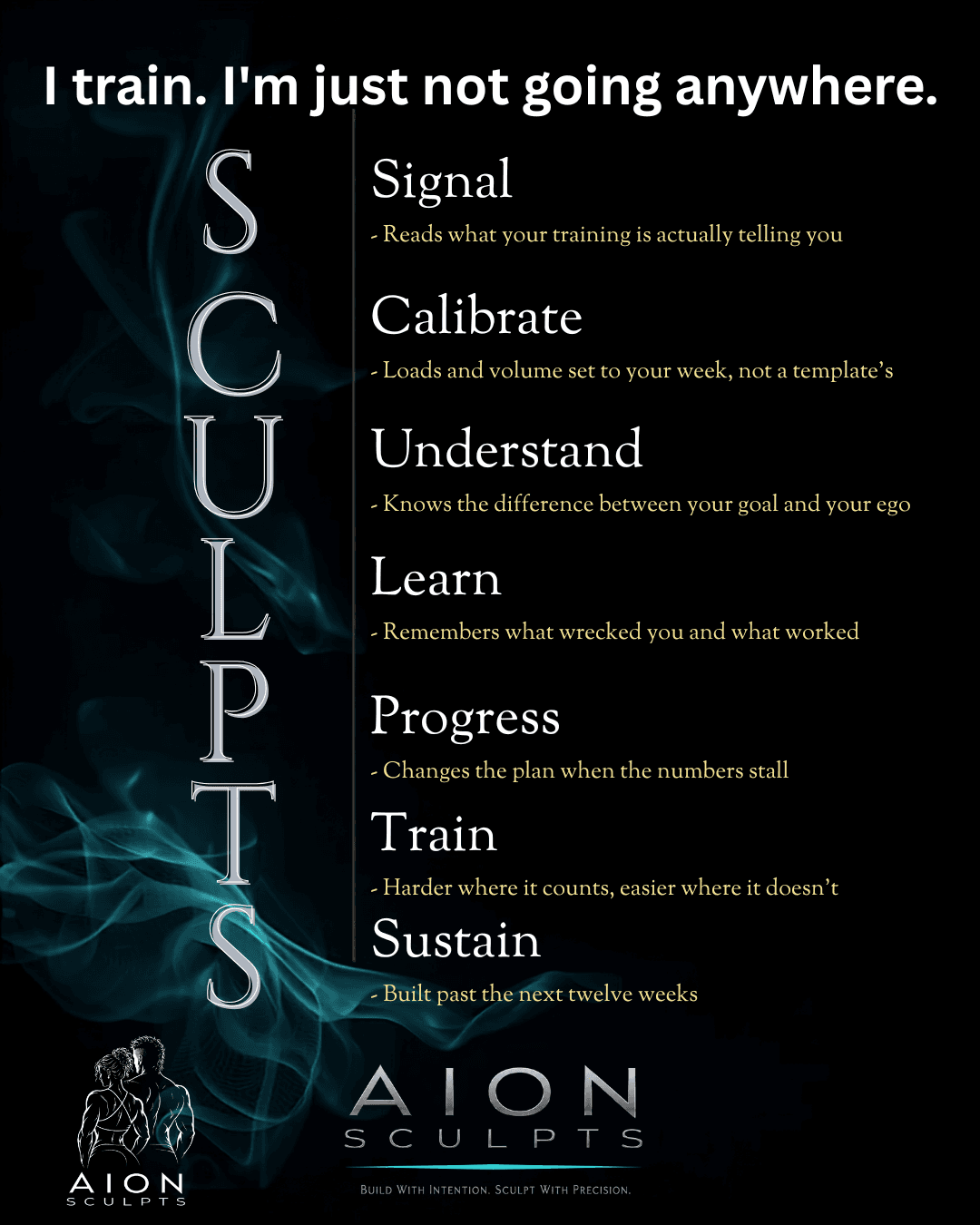
Not lacking discipline. You have been showing up for months.
What is missing is someone who remembers what you lifted in March and changes the plan instead of printing the same one again. A program you have run unchanged for three months is a program your body has already solved.
Here is what AION does with that, step by step.
Signal
He reads what your training is actually telling him. Not what you meant to do — the logged sets, the reps that came off, the sessions that quietly moved to Saturday every week for a month. The signal is usually already in your own data, unread.
Calibrate
Loads and volume set against your week, not a template’s. The week you had after four hours of sleep and the week you had on holiday should not produce the same prescription, and a plan that cannot tell them apart will eventually be wrong in both directions.
Understand
He knows the difference between your goal and your ego. Those pull in opposite directions more often than anyone admits — the number you want on the bar this week against the thing you said you were training for. A coach worth having occasionally says the boring one.
Learn
He remembers what wrecked you and what worked. Told once: the shoulder that objects to overhead pressing, the split that fell apart in week three, the accessory work that finally moved your bench. He does not reset every Monday and he does not ask you to re-explain your own history.
Progress
He changes the plan when the numbers stall. That is the whole difference between a plan and a document.
Worth saying plainly, though: when the thing that stalled is the scale rather than the bar, the honest first move is usually better information rather than more restriction. The most replicated finding in this area is that intake gets under-recorded and activity gets over-estimated, in the same direction, by people doing everything right. He will tell you that before he tells you to eat less.
Train
Harder where it counts, easier where it does not. The instinct at a plateau is to add — more sessions, more volume, more cardio, more restriction, usually all at once and usually leaving you unable to tell which one mattered. Changing four things simultaneously is how you learn nothing.
Sustain
Built past the next twelve weeks.
Almost every program you have run had an end date, which means the question “what happens after?” was somebody else’s problem, usually yours. His name is the Greek word for the kind of time that does not run out — nothing here is counting down, and what he learns about your training in month two is still shaping the plan in year two.
The plateau is not a verdict
Months of consistent work that stopped producing results feels like proof of something about you. It is almost always proof of something about the plan — that it stopped being about you a while ago and nobody changed it.
You did the hard part already. The plan should have kept up.
Common questions
- Why am I training consistently but not progressing?
- Most often because the plan has not changed in months. A program you have run unchanged is one your body has already solved, and progression stalls quietly long before it becomes obvious. The second common cause is that the picture the plan runs on — what you eat, what you actually lifted — has drifted from reality.
- Should I train harder or change the program?
- Usually change what you are doing rather than add to it. Harder where it counts and easier where it does not beats more of everything, and more of everything is what most people reach for first because it feels like the responsible answer.
- How does an adaptive plan differ from a template?
- A template is written before it meets you and does not learn. An adaptive plan reads what your logged training is telling it, sets loads and volume against the week you actually had, and changes when the numbers stop moving instead of reprinting.
- Is a stall on the scale the same as a stall in training?
- No, and confusing them is expensive. Losing fat and gaining muscle at similar rates looks like total failure on a bathroom scale. Strength numbers, measurements and how clothes fit will catch what the scale hides.