“I’m good in the session. It’s the rest of the week.”
You're excellent for the hour they're in front of you. Then there are the other 167 — the skipped session, the unlogged meal, the 9pm question they didn't text you about. That's where clients quit.
Kelli and Jordan, Co-Founders, AION Sculpts ·
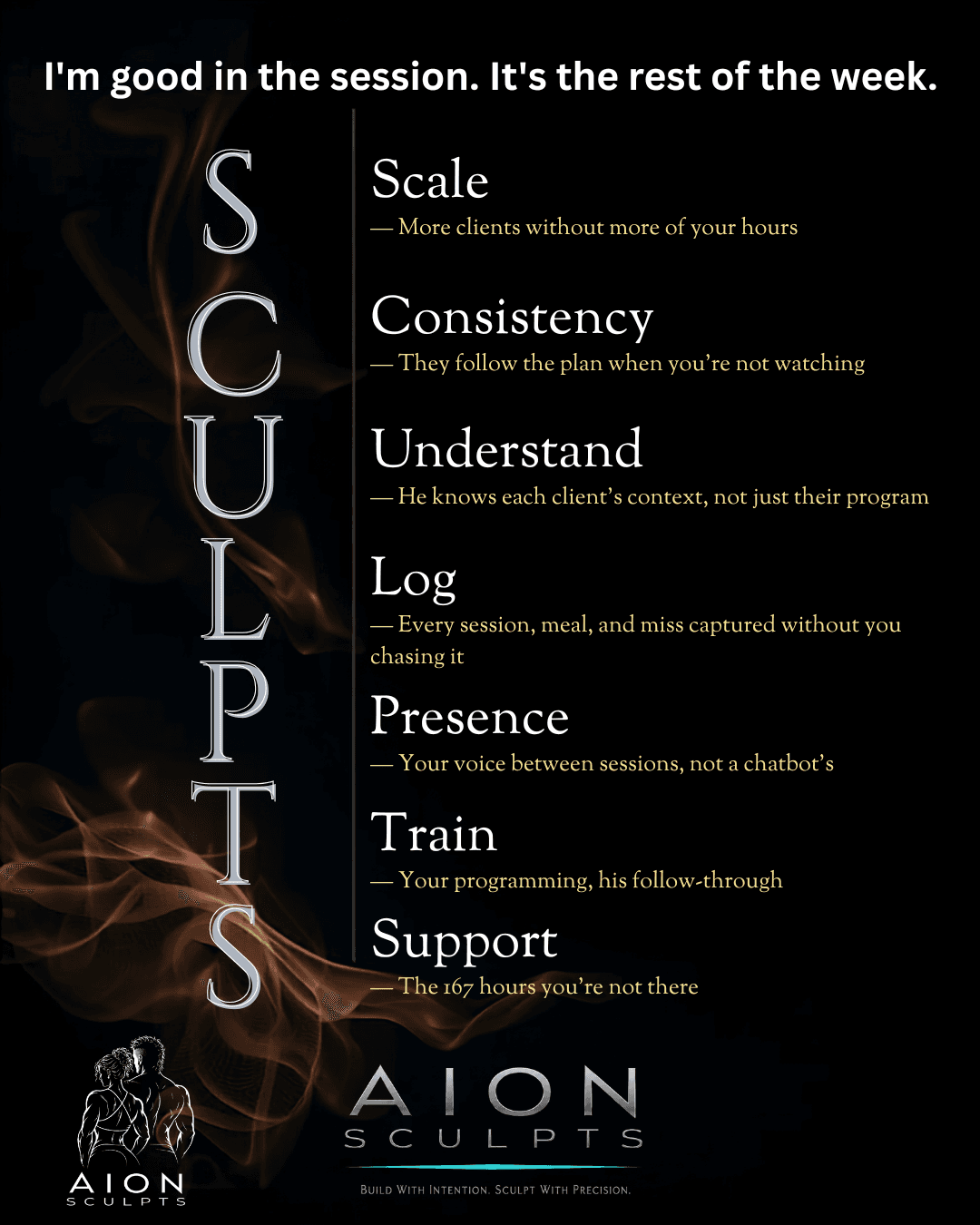
You are excellent for the hour they are in front of you. Then there are the other 167.
The skipped session. The unlogged meal. The 9 p.m. question they did not text you about because it felt too small to bother you with. That is where clients quit — not during your hour, and usually not loudly.
AION is your coach if you train alone. If you coach other people, he is your assistant. Here is what that means in practice.
Scale
More clients without more of your hours. Your capacity has always been capped by the time you can physically stand in a room, which means every new client costs you an evening somewhere. Take the program builds and the admin off that ledger and the cap moves.
Consistency
They follow the plan when you are not watching. Not because they are being policed — because the plan is in front of them, it adjusts when their week goes sideways, and the small question that would have derailed Wednesday gets answered on Wednesday.
Understand
He knows each client’s context, not just their program. The night shifts, the bad knee, the wedding in eleven weeks, the food they will not eat. Told once, and every plan afterward respects it — including the ones built at 11 p.m. on a Sunday when you are not available to remind him.
Log
Every session, meal and miss captured without you chasing it. The chasing is the part that quietly eats trainers — the reminder texts, the “did you log yesterday?”, the reconstruction of a week from memory at the start of a session that you are being paid to spend coaching.
Presence
Your voice between sessions, not a chatbot’s. He answers client questions in your voice and drafts your check-ins, nudges and celebrations the way you would write them — and every draft waits for your approval. He never messages a client on his own. The relationship stays yours, because it is the thing they are actually paying for.
Train
Your programming, his follow-through. A workout you wrote is saved word for word — not reinterpreted, not substituted, not “improved” by software that was not in the room when you watched that client move.
This is the line the whole thing is built on. He does not fix form, he does not spot, and he cannot read a body in real time. Those are yours, they are irreplaceable, and the industry data says clients still overwhelmingly want a human doing them.
Support
The 167 hours you are not there.
That is the whole proposition, and it is worth being precise about what it is not. It is not a cheaper version of you, and it is not a way for clients to need you less. It is the difference between a client who drifts for three weeks before you notice and one who never got the chance to.
Whether that changes what your book can hold is a question with an actual answer — the capacity calculator is free and takes a minute.
What he will not do with your clients
He is not a physician. He never diagnoses, never prescribes, and never tells anyone to start, stop or change a medication. He never tells a client to push through pain. A diagnosed medical restriction or an injury you have documented is a hard constraint he cannot override, and anything clinical goes back to the client’s medical team.
Those are rules he is given before he answers, not disclaimers at the bottom of a screen — which matters more to you than to anyone, because your license is the thing standing behind every message that goes out in your voice.
Common questions
- How do I keep clients on track between sessions?
- The gap is rarely knowledge and almost always the unwatched hours. What closes it is something that captures sessions and meals without you chasing them, answers the small questions when they arise rather than at your next session, and tells you who needs you before they go quiet.
- Will an AI assistant replace what I do?
- No, and it is built on the assumption that it should not. A trainer fixes form, spots, and reads a body in the room — none of which software does. The assistant covers the hours you are not being paid for, and hands the room back to you.
- Does it message my clients on its own?
- No. Drafts wait for your approval. Check-ins, nudges, celebrations and milestone notes are written in your voice and sent only when you send them.
- How many more clients can I actually take on?
- There is no fixed number, but the ceiling moves from hours available to relationships you can maintain well once programming and admin come off your plate. The client capacity calculator is the quicker way to answer it for your own book.