What Value Do You Put on Your Health?
Not whether your health matters — what your spending, your time and your calendar say it is worth. From our co-founder, who once found the money for drugs and now finds it for egg whites.
Jordan Woods, CEO & Co-Founder, AION Sculpts ·
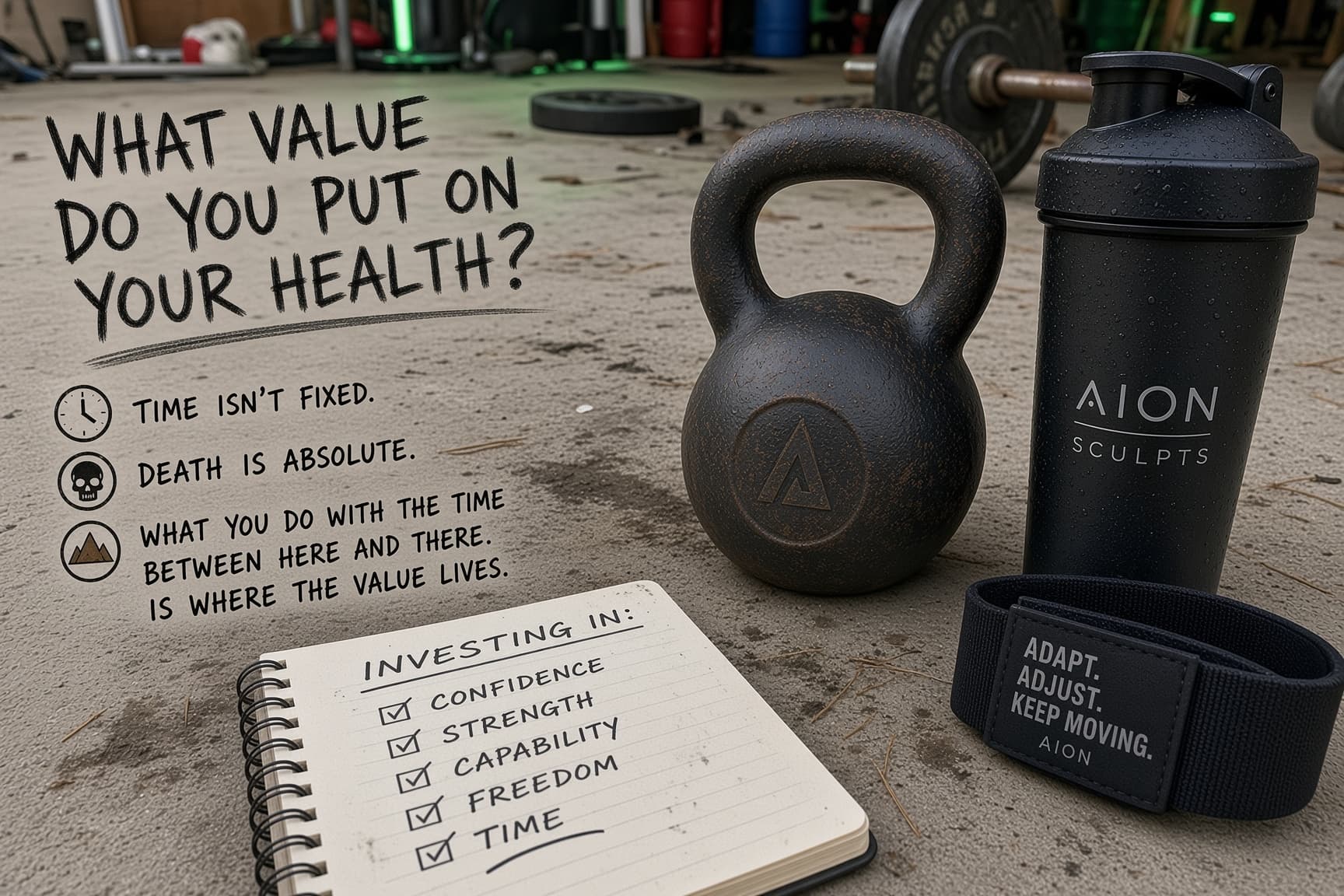
I’ve been thinking about this question a lot lately.
Not “Is my health important to me?” Most of us would answer yes without hesitation.
The harder question is: What value do I actually put on it?
Because what we say we value and what our choices say we value aren’t always the same thing.
Some people spend $10 on coffee without thinking twice. Do that five days a week and it’s $200 a month. We pay for streaming services we barely watch, meals we could have made at home, Amazon purchases we probably didn’t need—and then $20, $50 or $100 toward our health suddenly feels expensive.
And yes, sometimes money really is that tight. I know that firsthand. This isn’t about pretending everyone has extra money sitting around.
It’s about asking ourselves an uncomfortable question: When we do have choices, where does our health fall on the list?
I can point that finger at myself because I have some experience with questionable priorities.
Still do.
I Somehow Found the Money
I’m a recovering addict.
There was a time in my life when my health had no value in the decisions I was making. I was destroying myself.
And you know what?
I somehow found the money for drugs.
Whatever the circumstances, however broke I was, somehow I could hustle enough to get what I had decided I needed.
Dark example? Absolutely.
But it taught me something I understand much better today: we can be remarkably resourceful when something becomes a priority.
These days, my priorities look very different. I spend money on protein and enough egg whites to personally concern the chicken population. I buy supplements. I make time to train. I try to pay attention to what my body needs.
Do I make every decision perfectly?
Hell no.
Valuing your health doesn’t mean mastering it.
It means continuing to make it a priority. Making the next better choice when you can. And when you don’t? You try again.
Sometimes You Notice the Value When It’s Gone
A recent injury has amplified all of this for me.
I haven’t been able to train the way I normally do, and I underestimated how much that would affect me mentally.
The timing hasn’t exactly been ideal, either.
I’ve been going through heartbreak. I’m launching a fitness and wellness company. There are people depending on me. There are deadlines, decisions, problems, a very real shortage of money, and all the normal pressures of life.
Normally, the gym is one of the places I process all of that.
Then suddenly, I couldn’t.
It made me realize that when I invest in my health, I’m not just investing in muscles, body fat percentages or how I look in a mirror.
Although, let’s not get carried away. I’m still vain. I want results.
But I’m also investing in confidence. Strength. Capability.
I’m investing in having a body that allows me to live the life I want to live.
And ultimately, I’m investing in something much more valuable.
Time.
You Can’t Buy Yesterday
There was a point in my life when I was slowly dying.
Of course, in a very literal sense, we all are. Death is one of the few absolutes none of us gets to negotiate.
That doesn’t make life bleak to me.
It makes it valuable.
Because I can’t get yesterday back.
I can make more money. I can build a business. I can replace things I’ve lost. I can change direction when a plan falls apart.
But I cannot manufacture another Tuesday.
So maybe the value of health isn’t simply about adding as many years as possible to your life.
Maybe it’s about what your body allows you to do with the years you have.
Travel. Lift something heavy. Chase your kids around. Hike the trail. Get on the floor and get yourself back up. Feel confident walking into a room. Say yes to an adventure without wondering whether your body can handle it.
Whatever living means to you.
That’s what you’re investing in.
So, What Do Your Choices Say?
Here’s the uncomfortable question I’ve been asking myself:
If someone could only see where I spend my time, money and energy—not hear what I say is important to me—what would they conclude I value?
I don’t love every answer.
That’s okay.
I’m not finished.
None of us are.
Ironically, I’m being forced to live one of the principles behind AION Sculpts right now. We built Aion around the reality that life doesn’t follow the damn plan.
Injuries happen. Schedules change. Motivation disappears. Relationships end. Work gets insane. You miss workouts. You make choices you wish you hadn’t.
The goal doesn’t have to disappear just because the original path did.
You adjust. You reroute. You keep moving.
Because your health doesn’t require perfection.
But I do think it deserves a place pretty damn high on the list of things worth your time, your effort and, yes, your money.
You only get so much time.
What value are you putting on yours?
Build with Intention. Sculpt with Precision.
About the author
Jordan Woodsis Co-Founder and CEO of AION Sculpts, the company behind AION — an adaptive coaching AI built on the principle that systems beat hustle and honesty beats optimism. This piece is her own experience, told in her own words.
This article is a personal essay and general education. It is not medical, psychological, financial or treatment advice for any individual. If you are struggling with substance use, the SAMHSA National Helpline is free, confidential and open 24 hours a day, 7 days a week — 1-800-662-4357.
Common questions
- How much should I spend on my health?
- There is no universal number, and anyone who gives you one is guessing about your life. The more useful question is a comparison: look at what you already spend without thinking about it in a month — coffee, subscriptions, delivery, impulse buys — and ask where your health sits against that list. Sometimes money really is that tight, and that is real. This is about the choices you do have.
- What if I genuinely cannot afford a gym or an app right now?
- Then start with what costs nothing. Walking is free. Bodyweight training at home is free. Sleep is free. Drinking more water is free. Cooking at home is usually cheaper than not. Money is one way to invest in your health, but time, attention and effort are the others — and they are the ones most people are actually short on.
- Is it worth investing in my health if I am already exhausted and busy?
- That is usually the argument for it rather than against it. What you are buying is not a body-fat percentage. It is capability — the energy to get through the day, the confidence to walk into a room, a body that lets you say yes to things. Those are the assets that make a busy life survivable rather than the thing competing with it.
- Do I have to be perfectly consistent for it to count?
- No. Valuing your health does not mean mastering it. It means making it a priority again after the weeks when you did not. Injuries happen, schedules change, motivation disappears. The goal does not have to disappear just because the original path did.