What separates a coaching app from a chatbot
Both let you type a question and get a sensible answer back. The difference shows up in week three — here are four tests that tell them apart.
Kelli and Jordan, Co-Founders, AION Sculpts ·
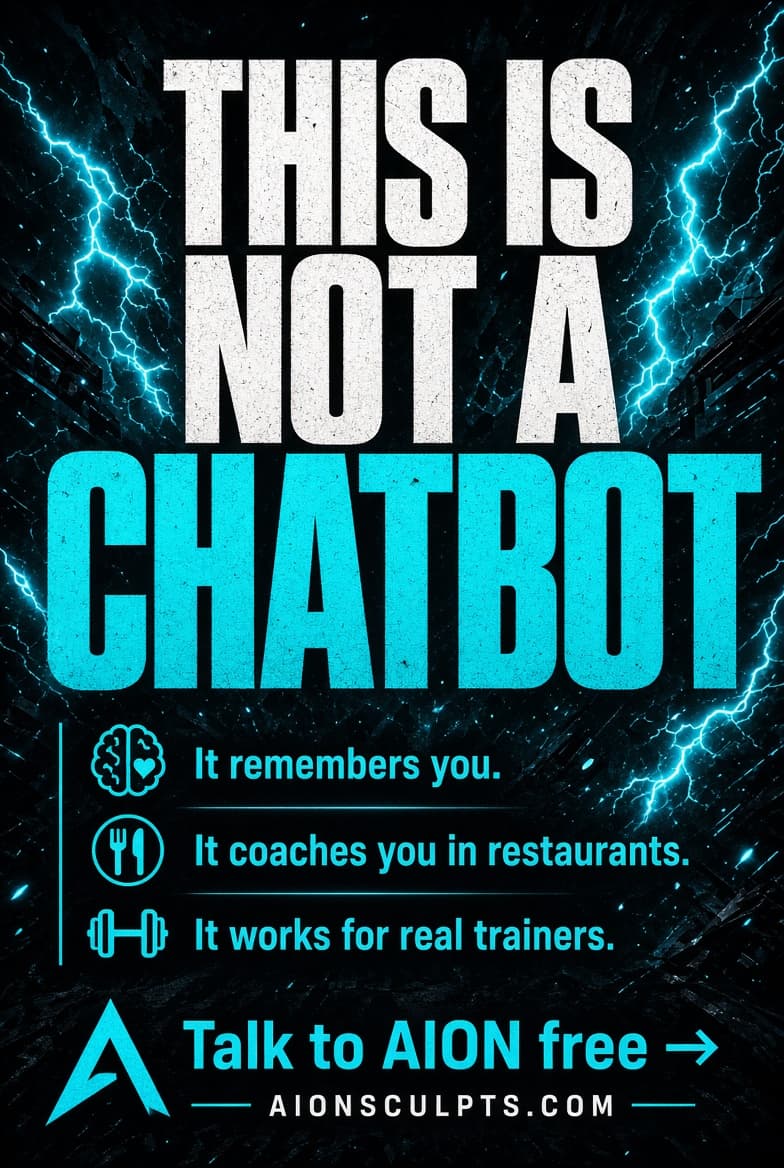
A chatbot answers the question you just asked. A coaching app carries what you said into everything it builds afterward. Both feel identical on day one — you type something, you get something sensible back — and the difference only becomes visible around week three, when one of them still knows who you are.
Four tests separate them, and you can run all four in a fortnight.
1. Does it remember, or does it re-ask?
Tell it something specific and awkward — a knee that dislikes deep flexion, a dairy rule with an exception, a Thursday that never works. Then wait a week and look at something it built that you did not prompt.
A chatbot handles your constraint beautifully in the message where you mention it, and has no idea about it in the next conversation. That is not a flaw — it is what the format is. It is simply a poor fit for something you intend to do for a year.
2. Is there a plan underneath, or only answers?
Ask for a workout twice, a week apart. If the second one has no relationship to the first — no progression, no memory of what was hard, no sense of a week having a shape — you are getting generated content rather than a program.
This is the difference that matters most over months. Training works through progressive overload, which requires something to remember what the previous load was. A sequence of individually good workouts, each starting from zero, is not the same as training.
3. Does saying something change anything?
Say “move Sunday’s session to Monday” and see whether the week actually reorganizes, or whether you get a paragraph explaining how you might reorganize it. Advice and action look similar in a chat window and are entirely different products.
The related test: does it require you to know the right phrasing? Real conversational software absorbs the way people actually talk — “my shoulder is being weird”, “I’ve got thirty minutes and one dumbbell” — rather than requiring you to find the magic words that map to a setting.
4. Will it ever tell you to do less?
Software built to maximize engagement always has another session to suggest. Something built to coach will occasionally tell you that this week is a week to back off, that the soreness you are describing means the last session was too much, or that the honest answer to “should I add a fourth day” is no.
A coach who only ever says push harder is not coaching. The same is true of an app.
Where Sculpt sits
AION is built for the second column of that comparison. Constraints stated once are held permanently and applied to everything built afterward. Plans persist and progress rather than being regenerated from scratch. Saying what changed reworks the week rather than producing advice about reworking it. Meals are built from what is already in your kitchen, and a menu you photograph in a restaurant gets read against the goals and restrictions it already knows about.
The honest boundary: none of that is clinical judgement. It programs around what you tell it, and questions about pain, medication or a health condition belong with a professional rather than with software.
The free tools here are the ungated version of the same idea — the starting planner and seven others, complete results, no account.
Common questions
- Can't I just ask a general assistant to write me a workout plan?
- You can, and the plan will often be reasonable. What you will not get is continuity: it does not hold your training history, it does not know what you lifted last week, and next month's plan will not be built on this month's. A one-off plan is a useful thing. It is a different thing from being coached.
- What should a coaching app actually do between sessions?
- Carry your constraints forward without being reminded, adjust the plan when you say something has changed, and keep the structure intact while it does. The measure is whether last week's information is visible in next week's plan without you re-entering it.
- Is a conversational interface just a gimmick?
- It is a gimmick when it is a form wearing a chat costume — a fixed sequence of questions with a typing animation. It earns its place when the thing you type changes what the software does, including in ways no form field anticipated.
- Should an app ever tell me to do less?
- Yes, and its willingness to is a fair test of what it is. Software optimized for engagement always finds a reason to add. Something built to coach will sometimes say the useful thing instead, which is that this week you should back off.