How to eat out without derailing your plan
Restaurants aren't the problem. Deciding at the table, hungry, with four people waiting on you is the problem — here's how to make the decision earlier.
Kelli and Jordan, Co-Founders, AION Sculpts ·
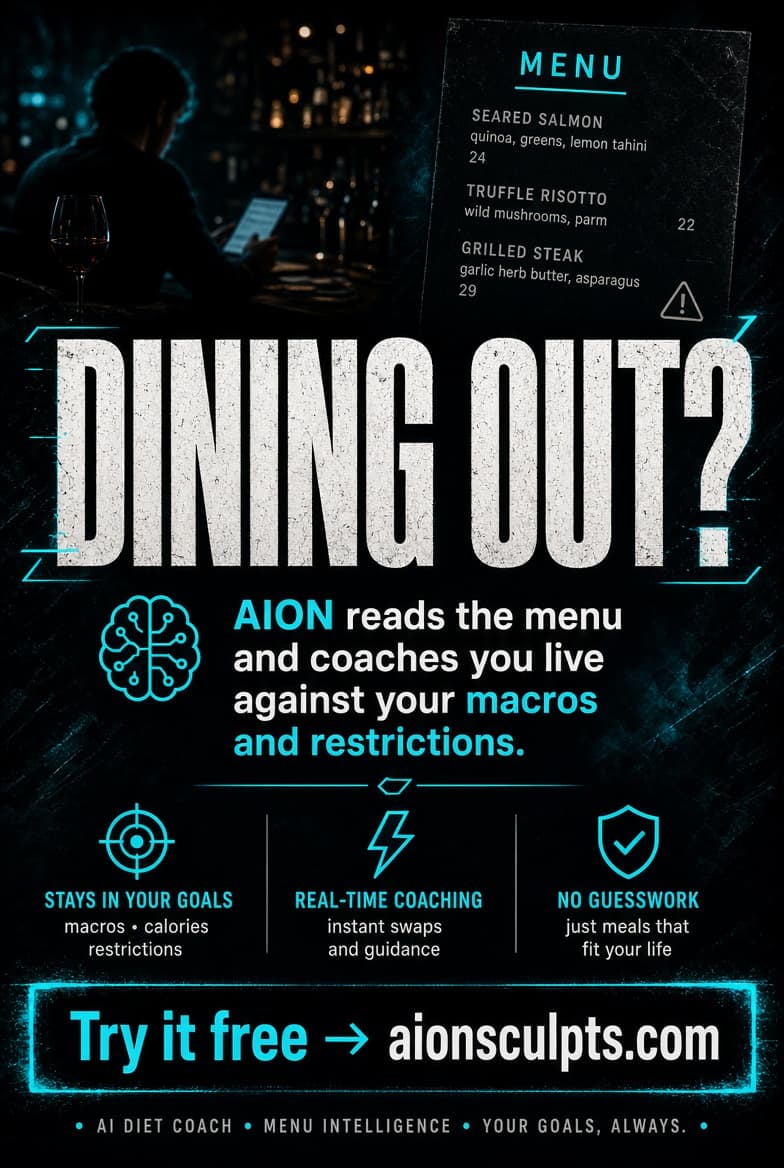
Look at the menu before you leave the house and decide then. That one habit does more than every rule about dressings on the side, because it moves the decision out of the worst possible conditions — hungry, at the table, with four people waiting and a server standing there — and into a calm two minutes at home.
Restaurants are not the thing that undoes people’s eating. Deciding under pressure is.
Order by method, not by section
Menu sections tell you what kind of dish something is. Cooking methods tell you what actually happened to it, and that is the more useful signal.
- Grilled, roasted, baked, steamed, braised, seared — the food is mostly itself.
- Crispy, battered, creamy, smothered, loaded, glazed — something rich was added, often generously.
This is not a list of good and bad foods. It is a way of knowing which one you are choosing, so that when you pick the second kind it is because you wanted it rather than because the menu described it in a way that concealed it.
Anchor the plate
A workable default in almost any restaurant, in any cuisine: a protein you can name, a vegetable that is not a garnish, and a starch you actually want rather than one that arrived by default. Steak and vegetables. Chicken and rice. Fish and potatoes. Dal and bread.
The reason this works is that it is memorable enough to use while distracted, which no more precise system is. If you want the numbers behind the protein half of that, the protein calculator is free and takes about thirty seconds — though not at the table.
Restrictions: say it once, early, plainly
“I can’t have dairy — which of these would work?” is a better sentence than a paragraph of apology, and it puts the kitchen’s knowledge to work instead of making you guess from the description.
Where it gets genuinely difficult is restrictions with exceptions — lactose intolerant but aged cheese is fine, no shellfish but fish is fine, gluten by choice rather than coeliac. Those do not survive being compressed into one word, and they are exactly the cases where a thoughtless simplification produces a worse meal than the truth would have.
Stop auditing the meal afterwards
Restaurant portions resist estimation. A logged restaurant meal is mostly a guess written down with false precision, and the ritual of entering it tends to produce more anxiety than information.
One meal does not move the picture. What moves the picture is whether eating out feels compatible with what you are doing or feels like a breach — because the second version is what makes people quit the plan rather than the meal.
Where Sculpt sits
This is one of the places AION is genuinely useful in the moment. Photograph the menu at the table and it reads it against what it already knows — your goals and the restrictions you told it once, exceptions included — and tells you which dishes fit and what to adjust. You are not explaining your dairy rule again in a dark restaurant; it already has it.
The same memory does the quieter work at home, where meals get built from what is already in your kitchen rather than from a shopping list. More on that in eating better without eating boring.
Common questions
- How do I order at a restaurant when I'm trying to eat better?
- Choose by cooking method before you choose by dish. Grilled, roasted, baked, steamed and braised describe how something was cooked; crispy, creamy, smothered and battered describe how it was enriched. Neither is off-limits, but knowing which you are picking is most of the decision.
- Should I look at the menu before I go?
- Yes, and it is the single highest-leverage habit here. Deciding at home, unhurried, is a completely different decision from deciding at the table while hungry with people waiting. Most restaurants post menus online; the choice takes two minutes and removes the hard part entirely.
- How do I handle dietary restrictions without making it awkward?
- State it once, early, as information rather than as a request for sympathy: "I can't have dairy — which of these would work?" Kitchens field this constantly and would far rather hear it when the order is placed than after the plate arrives.
- Do I need to track a restaurant meal?
- For most people, no. Restaurant portions are genuinely hard to estimate and the number you write down is largely invented, which makes the exercise more stressful than useful. Ordering thoughtfully and moving on is a more sustainable habit than a fictional entry in a log.