Days 8 Through 14: How to Read Your Own Data and What to Do the Day After You Break It
A plateau doesn't break on the scale. It breaks in the weekly average, the tape measure, and your hunger pattern. Here's how to read the data honestly — and the one decision on day fifteen that determines whether it stays broken.
Kelli Owens, Co-Founder, AION Sculpts ·

Build with Intention. Sculpt with Precision.
The short version:A plateau breaks between days eight and fourteen — but not on any single morning’s scale reading. It breaks in your weekly average, your measurements, and your hunger pattern. This article covers how to read those signals without lying to yourself, what to do when the data says it didn’t work, and the one decision on day fifteen that determines whether you broke the plateau or just postponed it.
Why the scale is the wrong tool this week
By day eight you’ve been at this a week. Your instinct is to step on the scale and let it tell you whether this worked.
Don’t.
The scale weighs everything at once: fat, muscle, water, glycogen, last night’s sodium, the contents of your digestive tract, the hormonal water retention that arrives on a monthly schedule, and the inflammation from a hard training session two days ago. It reports all of that as one number.
That number is not your fat.
For most healthy adults, body weight swings by roughly one to two kilograms — two to four pounds — across a few days, driven almost entirely by fluid and gut contents [1]. Even in carefully monitored weight-loss maintenance studies, weight follows a measurable weekly rhythm, typically running higher after the weekend [2][3]. If you’re losing half a pound of fat a week, that signal is sitting underneath four pounds of noise.
This is why single-day weigh-ins are useless and weekly averages aren’t.
Here’s the protocol for days eight through fourteen:
Weigh every morning. Same time, same conditions — after the bathroom, before eating, minimal clothing. Write the number down. Do not react to it. On day fourteen, add the seven numbers and divide by seven. Compare that to your week-one average.
A drop of half a pound to a pound and a half in the weekly average is real. The scale doesn’t have to fall every day, or even most days. The average is the signal. Everything else is weather.
What the tape measure sees that the scale can’t
The scale tells you your weight. A tape measure tells you your shape. When they disagree, the tape is usually the more useful one.
Here’s why — and let’s correct something you’ve heard a hundred times.
Muscle does not weigh more than fat. A pound is a pound. Muscle is denser— it occupies less space per pound. That’s the whole thing, and it matters, because it means you can lose fat and hold muscle and end up smaller at the same body weight. Your clothes know before your scale does.
When protein is adequate and you’re moving, that’s exactly what the last week was engineered to produce: fat down, lean tissue protected. The scale is blind to that trade. The tape isn’t.
On day eight, take four measurements. Waist at the narrowest point. Hips at the widest. Upper arm at mid-bicep. Thigh at mid-quad. Same time of day, same tension on the tape, write them down.
On day fourteen, take them again.
Half an inch off your waist with the scale unchanged is not a disappointment. It’s the outcome the protocol was built for.
Trend versus noise
This is the part most fat loss content skips, because it requires honest arithmetic and most people would rather have reassurance.
A real trend looks like this: your seven-day average in week two is lower than week one, and the direction holds into week three. It does not mean every day is lower than the last. It does not mean the scale never rises.
Noise looks like this: one low morning followed by three high ones. Two pounds after a restaurant meal, gone in three days. A dramatic swing after a long sleep or a heavy water day. These feel enormous and mean nothing about fat.
The skill this window teaches is the difference between reacting to a number and reading a direction. Most people never build it, because they quit somewhere around day ten — in the middle of the noise, before the trend has enough data points to show itself.
Reading your day-fourteen data honestly
Four outcomes. All four are information.
Scale average down, measurements down. The plateau broke. Two independent measures agree. Go to the day fifteen section.
Scale average flat, measurements down. The plateau broke. You lost fat and held lean tissue, and the scale can’t see that trade. This is a composition win and it counts. Don’t let a number talk you out of it.
Scale average down, measurements flat. Likely water, not fat. This is the common false positive — a drop in sodium, inflammation, or hormonal retention moving the scale without changing tissue. Run another seven days before drawing conclusions.
Scale average flat, measurements flat. It didn’t break. That’s uncomfortable and it deserves a real answer rather than encouragement.
If nothing moved
Four things to check, in order of how often they’re the culprit:
Portion drift.This is the answer far more often than anything else. Tracking accuracy degrades over two weeks without anyone noticing — the oil in the pan, the handful while cooking, the “about a cup.” Weigh your food for three days and compare it to what you logged.
Protein.Every meal should clear 30g. If you were substituting or skipping, that’s the first thing to fix.
Sleep.In a controlled trial, dieters eating identical calories lost 55% less fat and 60% more lean mass sleeping 5.5 hours versus 8.5 — while the scale showed roughly the same number both ways [4]. Small study, ten people, so hold the exact percentages loosely. But separately, extending sleep by about an hour cut daily intake by roughly 270 calories in a randomized trial [5]. If you ran this protocol on six hours of sleep, sleep is the variable — and no meal plan overrides it.
Something medical. Thyroid conditions, several common medications, and perimenopause all stall progress in ways that no protocol can out-cook. Two weeks of honest effort with zero movement on either measure is worth a conversation with your doctor, not another diet.
None of these is failure. Each has a specific correction. Identifying which one applies is the next step.
What to eat, days 8 through 14
Keep eating the plan.
That’s the whole instruction, and it’s deliberately boring. The nine recipes from the first week cover this one — rotate them the same way, hold the same carbohydrate rhythm, keep protein above 130g a day.
All nine recipes — full ingredients, macros, prep times, and storage notes — live in the Recipes section at AionSculpts.com.
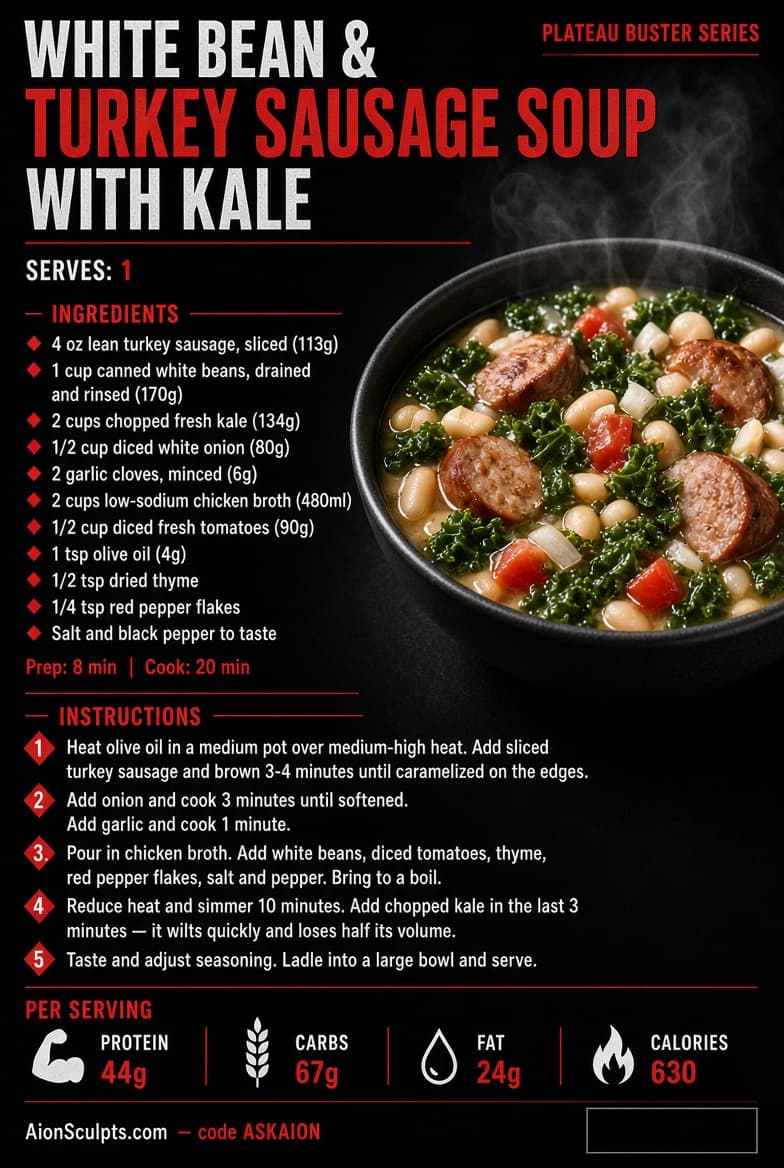
Week two is where elaborate meal plans die. The reason this one survives is that by now you’ve made most of these twice, you know which ones you actually like, and half of them are already in your fridge. Batch the soup. Build three jars of overnight oats on Sunday. Stop thinking about it.
One honest note: we’re not going to claim the spices get stronger the longer you use them. Curcumin in particular absorbs poorly and clears fast — it doesn’t build up in your system over two weeks. The reason week two works better than week one isn’t accumulating compounds. It’s that you’ve stopped negotiating with yourself about breakfast.
What’s happening to your hunger at day fourteen
By day fourteen, hunger is at its loudest.
That’s expected, and it isn’t a sign of failure. Losing fat lowers leptin, and the body’s response to that drop is disproportionate — hunger rises and energy expenditure falls further than the actual change in body size would justify [6][7]. In controlled studies, giving weight-reduced people replacement doses of leptin reversed much of it, restoring satiation and energy expenditure toward pre-diet levels [8][9].
Read that again, because it’s the most useful thing in this article: the hunger is a signal, not a weakness. It’s your body’s argument, not your verdict.
It also means day fifteen requires a specific response — and not the one your body is asking for.
The hardest part: day fifteen
Everything in this series has been building toward one decision. What you do the day after determines whether you broke the plateau or postponed it.
Most people do one of two things.
The relief response. They relax completely and return to the eating pattern that built the plateau in the first place, because they feel like they earned it. The pattern that produced the result disappears, and the old one comes back with it.
The overcorrection response. They see progress and try to accelerate — deeper cut, more cardio, harder push. This is worse. Every adaptation described in this series gets sharper at a steeper deficit. Hunger that was manageable at 1,500 calories becomes unmanageable at 1,100, and the rebound that follows undoes more than the two weeks gained.
Both are the same mistake wearing different clothes: reacting to the result instead of continuing the process.
The day fifteen protocol
Day fifteen isn’t a celebration and it isn’t a deeper cut. It’s the first day of holding what you built.
Calories: add 100 to 150, not 500. If you ran 1,500, eat 1,600. Do that for a week before deciding anything else.
We’ll be straight about the evidence here: the research on gradually easing out of a deficit — sometimes marketed as “reverse dieting” — is thin, and the strongest data on interrupted deficits comes from two-week blocks, not single days [10]. What a small, controlled increase reliably does is protect adherence and keep hunger from turning into a rebound. That’s a good enough reason. It is not a metabolic magic trick, and anyone selling it as one is guessing.
Protein: hold above 130g. This is the variable that decides whether the next phase continues or unravels. Intakes of 1.2–1.6g per kilogram during and after a deficit preserve lean mass better than eating at the RDA [11] — and the lean mass you protected over fourteen days stays protected only as long as the protein does. Dropping protein on day fifteen in favor of carbs is the single most common mistake in post-diet maintenance.
Movement: keep the walks. The ten minutes after breakfast, the standing block in the afternoon, the fifteen after dinner. These aren’t a workout and they don’t require motivation. They’re replacing the movement your body quietly cut when you started dieting — and it will cut it again the moment you stop.
Tracking: don’t stop. Fourteen days of data is your baseline. Everything you do from here gets measured against it. Stopping now is walking off the field before the score posts.
How not to rebuild the same plateau in eight weeks
The plateau you just broke was built by repetition — the same inputs, long enough for your body to fully adapt to them. Go back to those inputs and you’ll rebuild it.
The fix isn’t constant chaos. It’s deliberate variation at predictable intervals.
Every six weeks, run three to five days of one of these:
- A protein spike. Every meal built around a thermic protein source, above your normal intake.
- A volume block.Same calories, much lower energy density — the Day 3 and Day 6 style plates, where the food doubles and the number doesn’t.
- A carbohydrate cycle. Two low days, one deliberately higher, the way week one ran.
None of these requires a new protocol. They require understanding that adaptation is your body doing its job — and your job is to stay a step ahead of it.
The bottom line
A plateau breaks in the weekly average, the tape measure, and the hunger pattern. Not in Tuesday’s number.
Reading that data honestly — without needing it to say something specific, without reacting to a single day, without quitting right before the trend shows up — is the actual skill this series was built to teach. The recipes were the delivery mechanism.
You didn’t plateau because you failed. You plateaued because you succeeded long enough for your body to catch up.
Day fifteen is where you decide whether it catches up again.
Build with Intention. Sculpt with Precision.
AION is the coach. Sculpt is the system. One goal. One app. Done.
Full recipes → Recipes at AionSculpts.com — code ASKAION
About the author
Kelli Owensis Co-Founder, President and COO of AION Sculpts, the company behind AION — an adaptive coaching AI built on the principle that systems beat hustle and honesty beats optimism. She wrote and reviewed this article.
How this article was researched: Every claim is cited to primary literature. Where popular fat-loss claims didn’t survive review, we cut them — including “muscle weighs more than fat” (it’s denser, not heavier), the idea that turmeric’s effects accumulate over two weeks, and the framing of reverse dieting as a metabolic reset. Full reference list below.
This article is for general education and is not medical or dietary advice for any individual. Talk to your doctor or a registered dietitian before making significant changes, particularly if you have a medical condition, are pregnant, or take medication.
References
- Weight fluctuation in healthy adults: day-to-day variation of approximately 0.5–2 kg is common and attributable largely to fluid balance, glycogen, and gut contents. NHS Grampian clinical guidance, 2020.
- Turicchi J, O’Driscoll R, Horgan G, et al. Weekly, seasonal and holiday body weight fluctuation patterns among individuals engaged in a European multi-centre behavioural weight loss maintenance intervention. PLoS One. 2020;15(4):e0232152.
- Fuller N. How often should you really weigh yourself? University of Sydney / The Conversation, 2024 — reporting within-week body weight fluctuation of approximately 0.35%, typically higher after the weekend.
- Nedeltcheva AV, Kilkus JM, Imperial J, Schoeller DA, Penev PD. Insufficient sleep undermines dietary efforts to reduce adiposity. Ann Intern Med.2010;153(7):435–441.
- Tasali E, Wroblewski K, Kahn E, Kilkus J, Schoeller DA. Effect of sleep extension on objectively assessed energy intake among adults with overweight in real-life settings: a randomized clinical trial. JAMA Intern Med.2022;182(4):365–374.
- Camps SGJA, Verhoef SPM, Westerterp KR. Leptin and energy restriction induced adaptation in energy expenditure. Metabolism. 2015;64(10):1284–1290.
- Sumithran P, Prendergast LA, Delbridge E, et al. Long-term persistence of hormonal adaptations to weight loss. N Engl J Med. 2011;365:1597–1604.
- Rosenbaum M, Sy M, Pavlovich K, Leibel RL, Hirsch J. Leptin reverses weight loss–induced changes in regional neural activity responses to visual food stimuli. J Clin Invest.2008;118(7):2583–2591.
- Kissileff HR, Thornton JC, Torres MI, et al. Leptin reverses declines in satiation in weight-reduced obese humans. Am J Clin Nutr. 2012;95(2):309–317.
- Byrne NM, Sainsbury A, King NA, Hills AP, Wood RE. Intermittent energy restriction improves weight loss efficiency in obese men: the MATADOR study. Int J Obes.2018;42:129–138.
- Leidy HJ, Clifton PM, Astrup A, et al. The role of protein in weight loss and maintenance. Am J Clin Nutr.2015;101(6):1320S–1329S.
Common questions
- How do I know if my plateau actually broke?
- Not from any single morning's weigh-in. Weigh every morning under the same conditions, write it down, do not react to it, then on day fourteen average the seven numbers and compare that to your week-one average. A drop of half a pound to a pound and a half in the weekly average is real. Read it alongside four measurements — waist at the narrowest point, hips at the widest, mid-bicep and mid-quad — taken on day eight and again on day fourteen.
- Why does my weight fluctuate so much day to day?
- Because the scale weighs everything at once: fat, muscle, water, glycogen, sodium, the contents of your digestive tract, hormonal water retention and inflammation from training. For most healthy adults body weight swings by roughly one to two kilograms — two to four pounds — across a few days, driven almost entirely by fluid and gut contents, and weight follows a measurable weekly rhythm that typically runs higher after the weekend. If you are losing half a pound of fat a week, that signal sits underneath four pounds of noise.
- Does muscle weigh more than fat?
- No. A pound is a pound. Muscle is denser, meaning it occupies less space per pound — which is why you can lose fat, hold muscle and end up smaller at the same body weight. Your clothes know before your scale does. That is exactly the trade a protein-adequate protocol is built to produce, and it is the trade the scale is blind to.
- My measurements dropped but the scale didn't move. Did it work?
- Yes. That is a composition win: you lost fat and held lean tissue, and the scale cannot see that trade. Of the four possible day-fourteen outcomes, two count as the plateau breaking — average down with measurements down, and average flat with measurements down. Scale down with measurements flat is the common false positive and usually water rather than fat, so run another seven days before concluding anything.
- What if nothing moved after two weeks?
- Check four things in order. Portion drift, which is the answer far more often than anything else — weigh your food for three days and compare it to what you logged. Protein, which should clear 30g at every meal. Sleep, which no meal plan overrides. And a medical cause: thyroid conditions, several common medications and perimenopause all stall progress in ways no protocol can out-cook, so two weeks of honest effort with zero movement on either measure is worth a conversation with your doctor rather than another diet.
- What should I do on day fifteen?
- Not celebrate and not cut deeper. Add 100 to 150 calories, not 500, and hold that for a week before deciding anything else. Keep protein above 130g — dropping it in favor of carbs is the most common mistake in post-diet maintenance, and the lean mass you protected stays protected only as long as the protein does. Keep the walks, and keep tracking. The research on easing out of a deficit is thin; what a small controlled increase reliably does is protect adherence and stop hunger turning into a rebound, which is reason enough without calling it a metabolic reset.