How to Eat Your Way Out of a Plateau
The scale stopped moving. Here's the 3-day plateau buster plan, what the research actually supports, and the honest timeline nobody gives you.
Kelli Owens, Co-Founder, AION Sculpts ·
Build with Intention. Sculpt with Precision.
You’ve been doing everything right. Tracking your food. Hitting your protein. Showing up on the days you didn’t feel like it.
And then one day the scale just stops.
Not a little. Completely.
Here’s the first thing you need to hear: this is not failure. This is your body doing exactly what it was built to do — adapt. The second thing you need to hear is that adaptation can be interrupted.
Not with less food. With different food.
This is what that looks like on a plate.
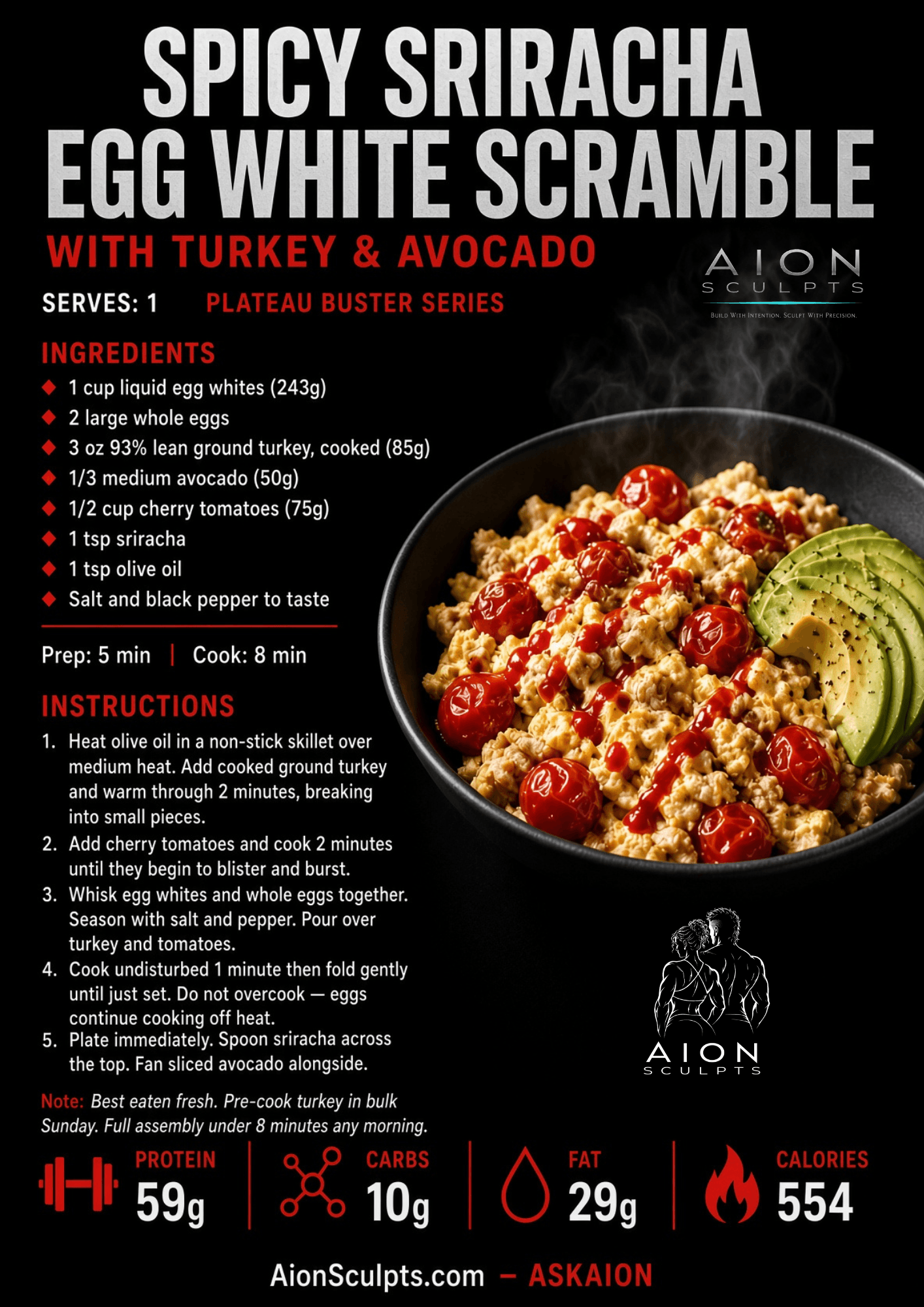
Fifty-nine grams of protein. Eight minutes. That’s breakfast on day one.
Not a shake. Not a bar. Not half a grapefruit and a prayer. Real food, built on purpose, that leaves you full until lunch. That’s the whole philosophy of this plan in one bowl.
Now let’s talk about why it works — and how long it actually takes.
Is three days enough to break a plateau?
Honest answer: no. And you deserve the real timeline instead of the marketing one.
Days 1–3.Your body starts responding to the disruption. Water retention shifts. Energy comes back. Appetite pressure eases. The scale may move — that’s mostly water, not fat.
Days 4–7. This is where the real change happens. One week of consistent plateau buster eating is the minimum meaningful window.
Days 8–14. This is where you confirm it. On the scale. In measurements. In how your clothes fit. Two weeks of different inputs gives you actual data instead of noise.
So why a three-day plan?
Because three days is what you’ll actually commit to. Tell someone “do this for two weeks” and you lose them on day four. Three days gets you through the door — and almost everyone who finishes three days keeps going, because by then they feel different.
Three days starts the disruption. Seven builds momentum. Fourteen breaks the plateau. Anybody promising you a broken plateau by Wednesday is selling you something.
The 3-Day Plateau Buster Plan
Three days. Three different jobs. The variation is the intervention.
Watch the carbohydrates across the three days: 60g, then 180g, then 96g. That swing is the strategy. Calories move too, but the carb rhythm is what does the work.
Every recipe below — full ingredients, prep times, and storage notes — lives in the Recipes section at AionSculpts.com.
Day 1 — The Ignition Day
Highest protein. Lowest carbohydrate. Maximum digestive cost, maximum satiety.
| Meal | Calories | Protein | Carbs | Fat |
|---|---|---|---|---|
| Spicy Sriracha Egg White Scramble with Turkey & Avocado | 554 | 59g | 10g | 29g |
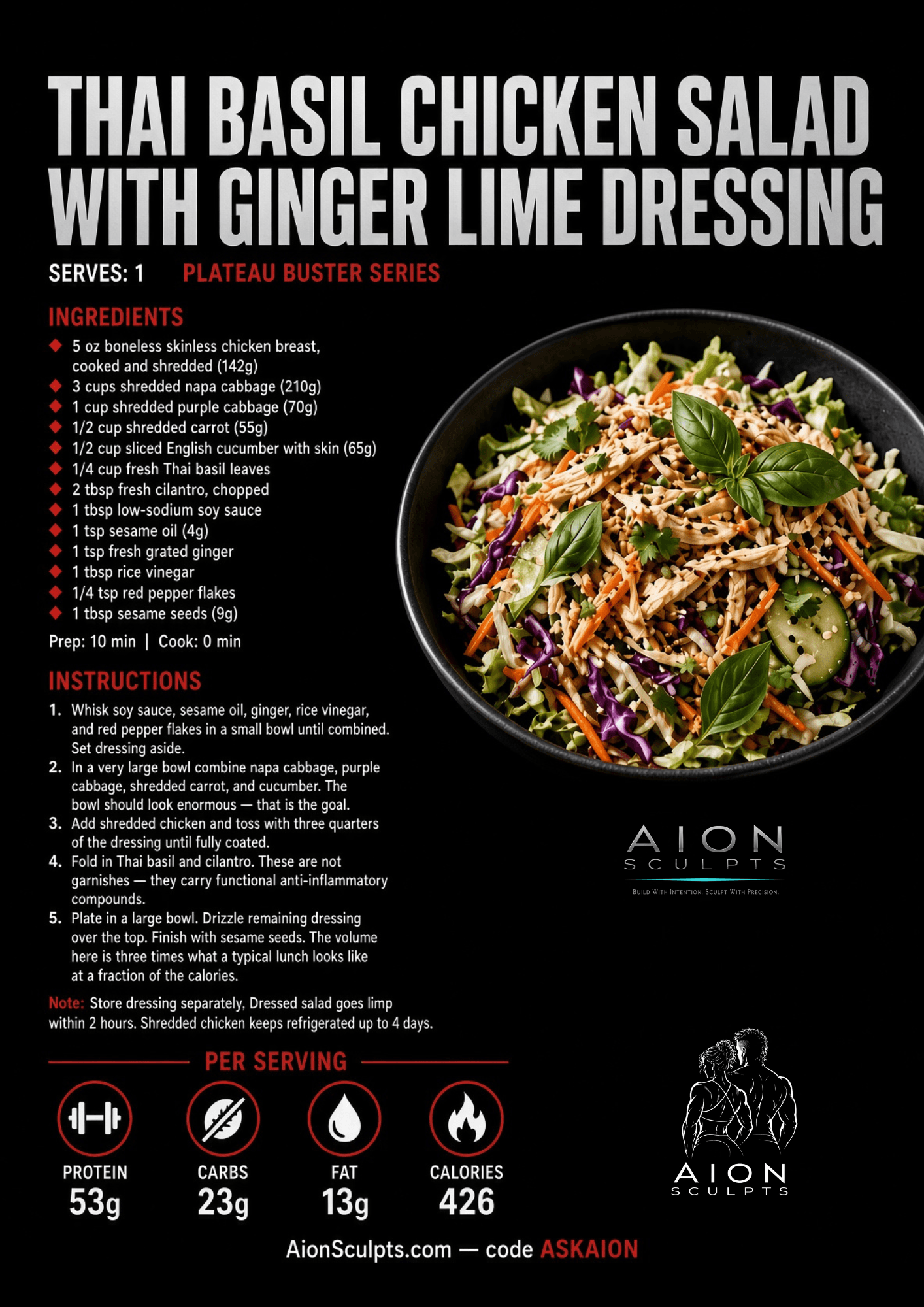
| Thai Basil Chicken Salad with Ginger Lime Dressing | 426 | 53g | 23g | 13g |
| Turmeric Black Pepper Chicken with Roasted Broccoli & Garlic | 425 | 41g | 27g | 19g |
| Day total | 1,405 | 153g | 60g | 61g |
Why this day works:153g of protein is the highest of the three days, and it’s not an accident. Protein costs your body 20–30% of its own calories just to digest — versus 5–10% for carbs and 0–3% for fat [5][6]. You spend calories eating it. More importantly, it protects the lean mass that holds your metabolic rate up.
Day 2 — The Cycle Up Day
Carbohydrates go up. On purpose. Read that again.
| Meal | Calories | Protein | Carbs | Fat |
|---|---|---|---|---|
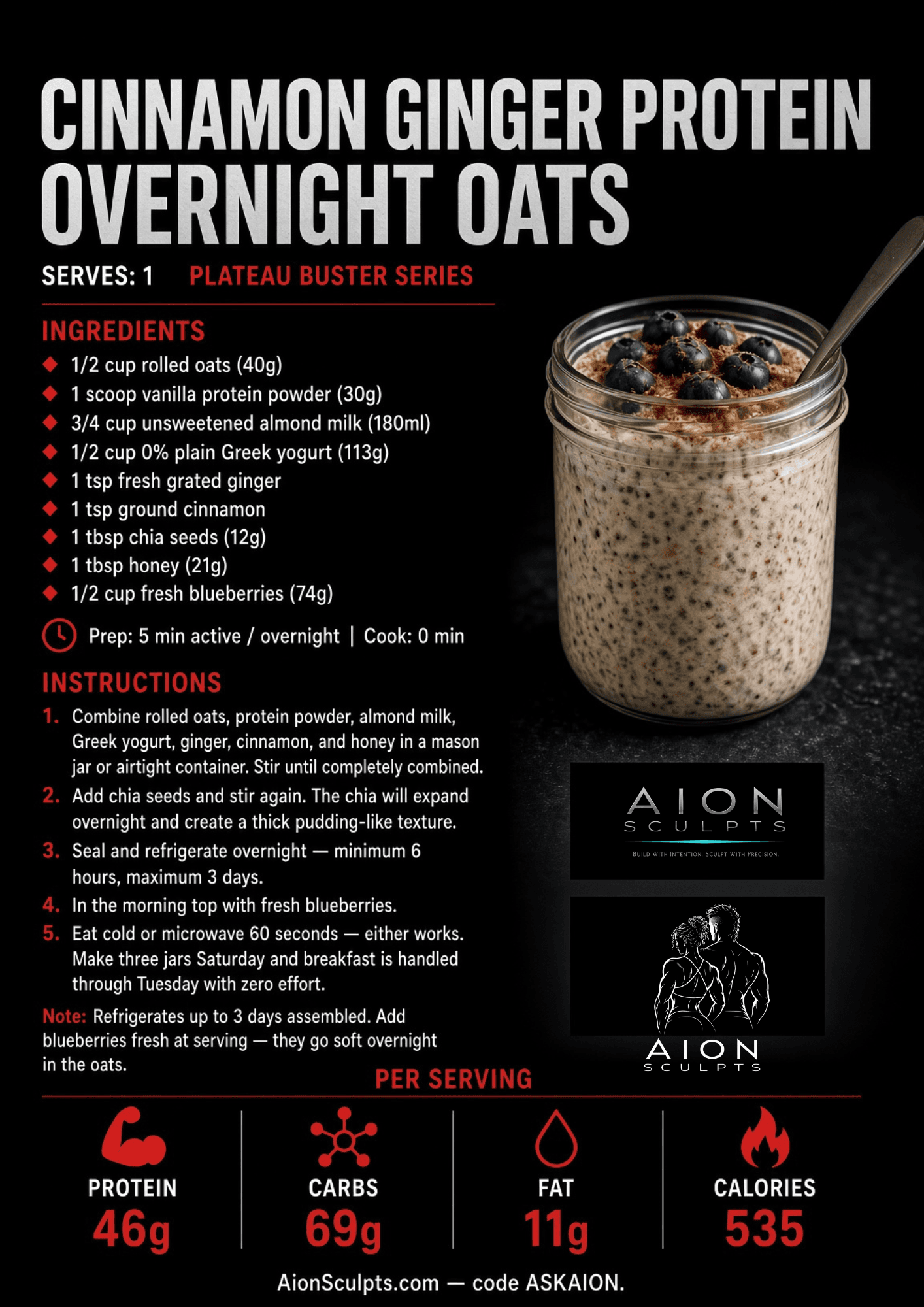
| Cinnamon Ginger Protein Overnight Oats | 535 | 46g | 69g | 11g |
| White Bean & Turkey Sausage Soup with Kale | 630 | 44g | 67g | 24g |
| Blackened Cod with Cinnamon Roasted Carrots & Baby Spinach | 402 | 33g | 35g | 16g |
| Snack: 1 cup plain nonfat Greek yogurt with ½ cup berries | 169 | 23g | 9g | 0g |
| Day total | 1,736 | 146g | 180g | 51g |
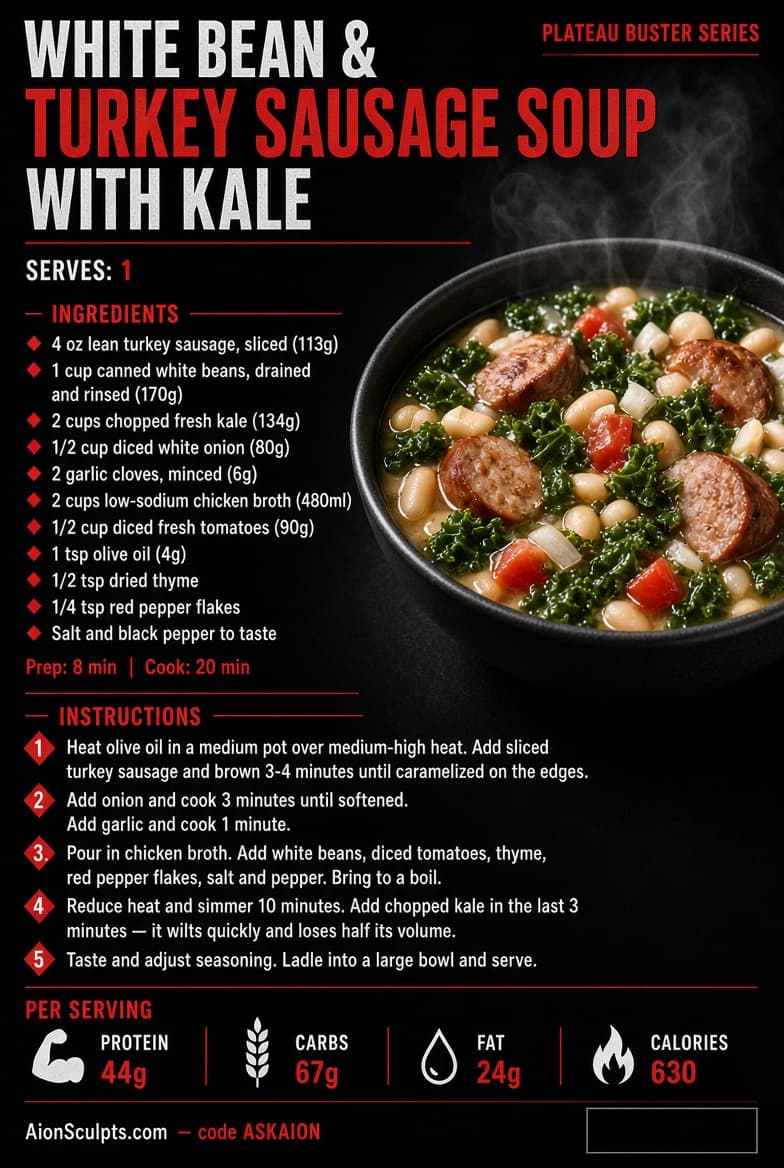
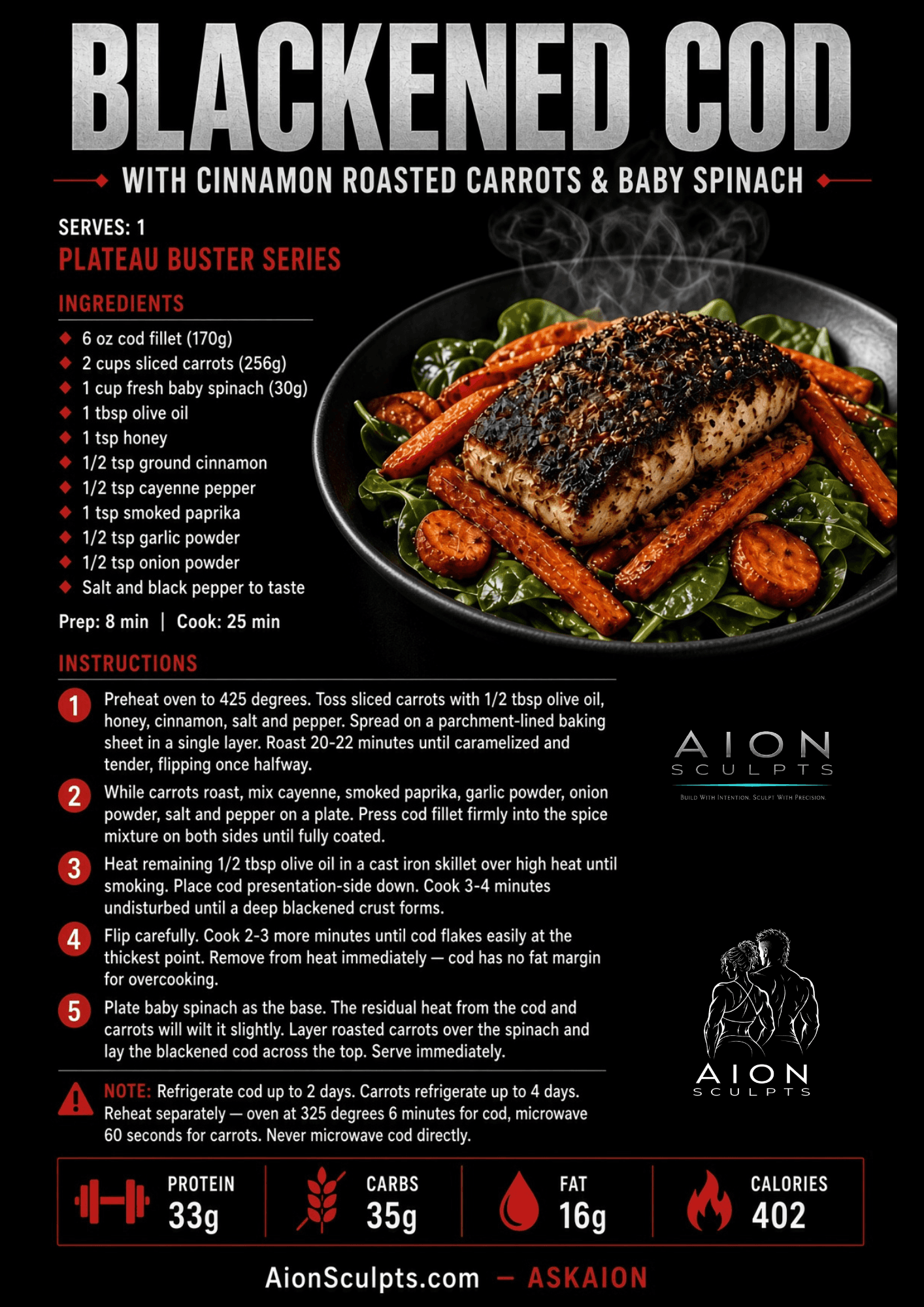
This is the day people want to skip. Don’t.
The strongest evidence for interrupting a deficit comes from the MATADOR trial, where men alternating two-week deficit blocks with two-week maintenance blocks lost substantially more fat than a continuous-deficit group with the same total restriction time — and showed smaller drops in resting energy expenditure [25].
But here’s the part we’re not going to dress up for you: MATADOR used two-week blocks. One higher-carb day is a refeed, not a diet break, and the evidence for single-day refeeds is thinner. Trials in trained dieters found refeed groups losing similar fat mass, with the benefit showing up in lean mass retention and training performance rather than fat loss [26][27].
So Day 2 earns its place by making the plan livable, refilling glycogen, and taking the pressure off your appetite. That’s a real job. It is not a metabolic reset, and we’re not going to tell you it is.
Day 3 — The Volume & Reset Day
Maximum food. Minimum calories. The three biggest plates in the set.
| Meal | Calories | Protein | Carbs | Fat |
|---|---|---|---|---|
| Turmeric Golden Protein Smoothie Bowl | 372 | 41g | 39g | 7g |
| Crunch Salad with Turmeric Vinaigrette | 521 | 51g | 15g | 28g |
| Baked Lemon Pepper Cod with Roasted Asparagus & Cauliflower Mash | 487 | 46g | 33g | 22g |
| Snack: 1 cup plain nonfat Greek yogurt with ½ cup berries | 169 | 23g | 9g | 0g |
| Day total | 1,549 | 161g | 96g | 57g |
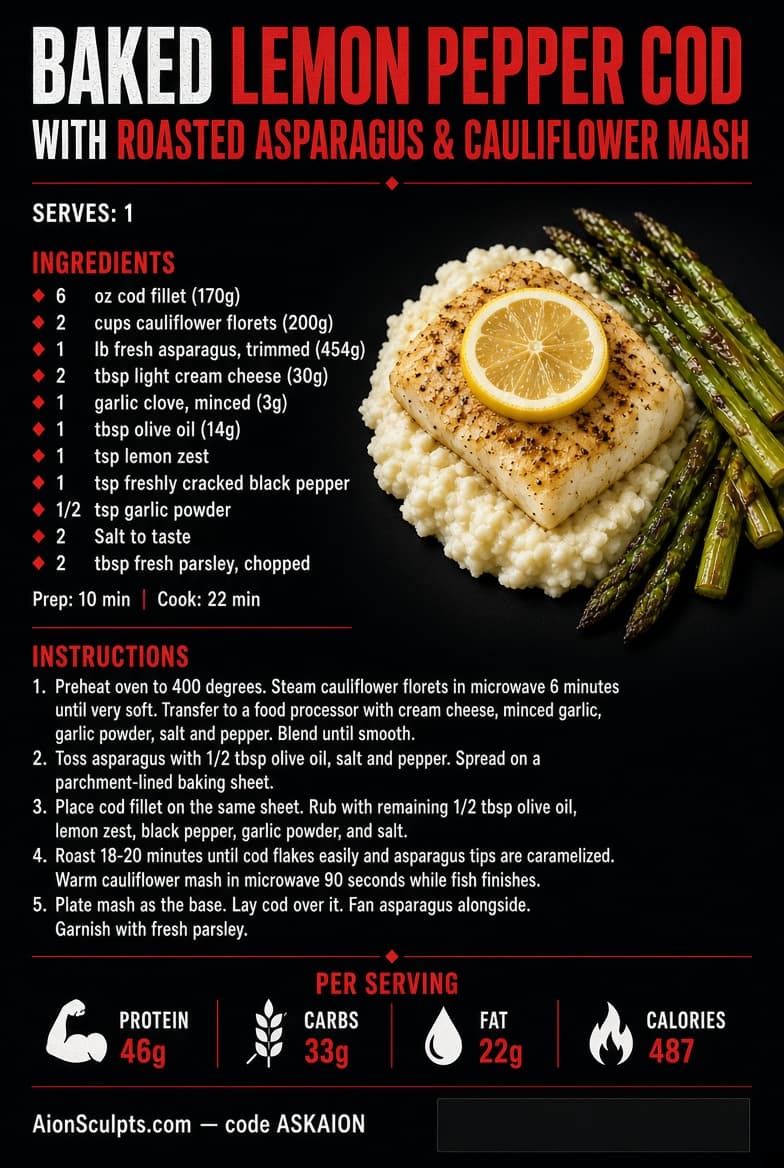
Why this day works: fullness is driven by the physical weight and volume of food as much as by its calories. In Barbara Rolls’ research, a large low-energy-dense salad before lunch cut total meal intake by about 12% — while a small high-energy-dense salad increased intake by 8% [8]. Lower the energy density of the whole diet and people eat less without being told to [9].
A pound of vegetables and a pound of pasta send very different signals for very different prices. Day 3 is that principle, three times.
Scale it to you
These numbers suit an average adult woman in a moderate deficit. If you’re taller, heavier, more active, or male — add. A cup of rice at dinner. An extra serving of protein. A second snack.
Do not go lower than what’s written.
Deepening the deficit is what created most plateaus in the first place. Three days of aggressive restriction buys you nothing but a bad mood and a slower metabolism.
Two non-negotiables: a fifteen-minute walk after dinner all three nights, and enough water that you stop thinking about it.
Macros are taken directly from each published recipe card. Treat them as ±10%.
Why the scale stopped in the first place
Now the part most articles lead with. You’ve got the plan — here’s the mechanism behind it.
A plateau shows up somewhere between week four and week twelve of a consistent deficit. Three things are happening at once.
You’re a smaller person now. A lighter body burns fewer calories doing the identical day. The deficit that worked in week one is close to maintenance by week ten.
Your energy expenditure drops more than your size predicts. This is adaptive thermogenesis, and it’s one of the most replicated findings in obesity research. After a 10% weight loss, both resting and non-resting energy expenditure fall below what body composition alone forecasts — and that gap persists in people who’ve kept the weight off for more than a year [1][2].
Your unconscious movement drops. Resting metabolic rate accounts for only about 30–50% of the total decline in energy expenditure after weight loss [3]. The rest is movement you never decided to cut — fidgeting, pacing, taking the stairs. Hunger hormones shift too. Leptin falls, ghrelin rises, and the same meal satisfies you less [4].
None of that is a character flaw. And none of it responds to “eat less and try harder.”
How big is metabolic adaptation, really?
Smaller than the internet tells you.
In a pooled analysis of 227 dieters, metabolic adaptation measured about 92 kcal/day below predicted at the end of active weight loss — and shrank to roughly 38 kcal/day after four weeks at a stable weight. Thirty-one percent of participants showed no measurable adaptation at all [3].
Your metabolism is not broken. Anyone selling you a “metabolic repair” protocol is overselling this literature.
That number also tells you what a real solution looks like. Stack the levers in this plan and you’re worth roughly 200–400 calories a day. Against a 40-to-90-calorie gap, that isn’t a rounding error. That’s the problem solved twice over.
The two levers nobody talks about
The post-meal walk. Brief light walking after eating consistently lowers post-meal glucose versus staying seated [15], and three 15-minute post-meal walks improved 24-hour glucose control in older adults at risk for glucose intolerance [16]. Said plainly: these are glucose studies, not fat-loss studies. Flatter glucose means steadier energy and fewer 3pm decisions you regret. It is not proof the walk melts fat.
Sleep.This is the one that beats every recipe on this page. In a controlled crossover trial, dieters eating identical calories lost 55% less fat and 60% more lean mass sleeping 5.5 hours versus 8.5 — while the scale showed essentially the same number both ways [17]. That study was small, ten people, so hold the exact percentages loosely. But the direction has held up in free-living dieters, and separately, extending sleep by about an hour cut daily intake by roughly 270 calories in a randomized trial [18].
If you’re plateaued on six hours of sleep, the recipes are not your problem.
What about cinnamon, turmeric, and ginger?
This is where the internet lies to you. So let’s be specific.
| Ingredient | What the evidence actually shows | Verdict |
|---|---|---|
| Cayenne & chili | Capsaicin genuinely raises energy expenditure — by about 50 kcal/day in systematic review [10], with another meta-analysis near 59 kcal/day [11]. Real, but small [12], and mainly in people with a BMI over 25 [13]. The appetite effect may matter more than the metabolic one [14]. | Helps because it makes you eat less. |
| Cinnamon | Lowers fasting and post-meal glucose — but almost entirely in people with type 2 diabetes or prediabetes, with high variability between studies [19]. A 2024 trial found 4g/day lowered 24-hour glucose in adults with prediabetes, yet produced no change on a glucose tolerance test [20]. | Great on your oats. Not a fat burner. |
| Turmeric + black pepper | The famous “2000% absorption” number comes from a single 1998 study in eight people. Independent labs haven’t reproduced a meaningful piperine effect [21][22]. | Excellent cooking. Unsettled science. |
| Ginger | A GRADE-assessed review of 27 randomized trials rated evidence certainty as low for body weight and body fat, very low for BMI and waist circumference [23]. A 2025 dose-response analysis found no significant BMI effect at all [24]. | Cook with it because it tastes incredible. |
And one claim we’re retiring for good: that varying your calories “keeps your metabolism guessing.” That’s a story, not a mechanism. Calorie variation works — when it works — through adherence, hunger management, and glycogen. Not confusion.
We could have left that line in. It sells better. We’re not going to.
If you only do three things
- Hit the protein. Every meal in this plan clears 33g and most clear 45g. That single change does more than every spice on this page combined.
- Walk fifteen minutes after dinner. All three nights.
- Sleep seven hours. Non-negotiable, and the highest-leverage item here [17][18].
The bottom line
A plateau isn’t the end of your progress. It’s information.
Your body adapted — which means your body is working exactly as designed. The only question is whether your strategy adapts faster than your metabolism does.
Three days won’t produce three pounds of fat loss. Any plan promising that is lying to you. What three days will do is drop retained water, restore your energy, ease your appetite, and prove the pattern changed. Weigh yourself the morning of day one and the morning of day five, and ignore everything in between.
If nothing has moved after two weeks of genuine consistency, the answer isn’t another recipe. It’s sleep, an untracked drift in portions, or a medical factor worth a conversation with your doctor. Thyroid conditions and several common medications stall progress in ways no meal plan can override.
Your body isn’t broken. The old plan just ran its course.
This is the new one.
Build with Intention. Sculpt with Precision.
AION is the coach. Sculpt is the system. One goal. One app. Done.
Full recipes → Recipes at AionSculpts.com — code ASKAION
About the author
Kelli Owensis Co-Founder, President and COO of AION Sculpts, the company behind AION — an adaptive coaching AI built on the principle that systems beat hustle and honesty beats optimism. She wrote and reviewed this article.
This article is for general education and is not medical or dietary advice for any individual. Talk to your doctor or a registered dietitian before making significant changes, particularly if you have a medical condition, are pregnant, or take medication.
References
- Leibel RL, Rosenbaum M, Hirsch J. Changes in energy expenditure resulting from altered body weight. N Engl J Med.1995;332:621–628.
- Rosenbaum M, Hirsch J, Gallagher DA, Leibel RL. Long-term persistence of adaptive thermogenesis in subjects who have maintained a reduced body weight. Am J Clin Nutr.2008;88(4):906–912.
- Martins C, Gower BA, Hunter GR. On adaptive thermogenesis: just another weight-loss tale? Am J Clin Nutr.2020;112(5):1157–1159.
- Management of Weight Loss Plateau. StatPearls, NCBI Bookshelf, 2024. https://www.ncbi.nlm.nih.gov/books/NBK576400/
- Westerterp KR. Diet induced thermogenesis. Nutr Metab (Lond). 2004;1:5.
- Diet induced thermogenesis, older and newer data with emphasis on obesity and diabetes mellitus — a narrative review. 2024. https://pmc.ncbi.nlm.nih.gov/articles/PMC11217690/
- Leidy HJ, Clifton PM, Astrup A, et al. The role of protein in weight loss and maintenance. Am J Clin Nutr.2015;101(6):1320S–1329S.
- Rolls BJ, Roe LS, Meengs JS. Salad and satiety: energy density and portion size of a first-course salad affect energy intake at lunch. J Am Diet Assoc.2004;104(10):1570–1576.
- Rolls BJ. Dietary energy density: applying behavioural science to weight management. Nutr Bull.2017;42(3):246–253.
- Whiting S, Derbyshire E, Tiwari BK. Capsaicinoids and capsinoids: a potential role for weight management? A systematic review of the evidence. Appetite.2012;59(2):341–348.
- Zsiborás C, Mátics R, Hegyi P, et al. Capsaicin and capsiate could be appropriate agents for treatment of obesity: a meta-analysis of human studies. Crit Rev Food Sci Nutr. 2018.
- Ludy MJ, Moore GE, Mattes RD. The effects of capsaicin and capsiate on energy balance: critical review and meta-analyses of studies in humans. Chem Senses.2012;37(2):103–121.
- Capsaicin for weight control: “exercise in a pill” (or just another fad)? Pharmaceuticals. 2022;15(7):851.
- Whiting S, Derbyshire EJ, Tiwari B. Could capsaicinoids help to support weight management? A systematic review and meta-analysis of energy intake data. Appetite.2014;73:183–188.
- Efficacy of postprandial exercise in mitigating glycemic responses in overweight individuals and individuals with obesity and type 2 diabetes: a systematic review and meta-analysis. Nutrients. 2023;15(20):4489.
- DiPietro L, Gribok A, Stevens MS, Hamm LF, Rumpler W. Three 15-min bouts of moderate postmeal walking significantly improves 24-h glycemic control in older people at risk for impaired glucose tolerance. Diabetes Care.2013;36(10):3262–3268.
- Nedeltcheva AV, Kilkus JM, Imperial J, Schoeller DA, Penev PD. Insufficient sleep undermines dietary efforts to reduce adiposity. Ann Intern Med.2010;153(7):435–441.
- Tasali E, Wroblewski K, Kahn E, Kilkus J, Schoeller DA. Effect of sleep extension on objectively assessed energy intake among adults with overweight in real-life settings: a randomized clinical trial. JAMA Intern Med.2022;182(4):365–374.
- Effects of cinnamon supplementation on metabolic biomarkers in individuals with type 2 diabetes: a systematic review and meta-analysis. Nutrition Reviews. 2025;83(2):249.
- Zelicha H, et al. Effect of cinnamon spice on continuously monitored glycemic response in adults with prediabetes: a 4-week randomized controlled crossover trial. Am J Clin Nutr. 2024;119(3):649–657.
- Shoba G, Joy D, Joseph T, Majeed M, Rajendran R, Srinivas PS. Influence of piperine on the pharmacokinetics of curcumin in animals and human volunteers. Planta Med.1998;64(4):353–356.
- Independent replication attempts of the piperine–curcumin bioavailability effect (Volak et al.; Flory et al.; Fança-Berthon et al.; Kroon et al., 2013–2025), which have not reproduced the original magnitude.
- Ginger intervention on body weight and body composition in adults: a GRADE-assessed systematic review and dose-response meta-analysis of 27 randomized controlled trials. Nutrition Reviews. 2024;82(12):1651.
- Impact of ginger supplementation on obesity indices and adipokine profiles in adults: a GRADE-based systematic review and dose-response meta-analysis of RCTs. 2025.
- Byrne NM, Sainsbury A, King NA, Hills AP, Wood RE. Intermittent energy restriction improves weight loss efficiency in obese men: the MATADOR study. Int J Obes.2018;42:129–138.
- Campbell BI, et al. Intermittent energy restriction attenuates the loss of fat-free mass in resistance-trained individuals: a randomized controlled trial. 2020.
- Peos JJ, Helms ER, Fournier PA, Krieger J, Sainsbury A. A 1-week diet break improves muscle endurance during an intermittent dieting regime in adult athletes (ICECAP secondary analysis). PLoS One. 2021;16(2):e0247292.
Common questions
- Is three days enough to break a plateau?
- No. Three days starts the disruption, seven builds momentum, and fourteen is where a plateau actually breaks. Days one to three shift water retention, ease appetite pressure and bring energy back — any scale movement in that window is mostly water rather than fat. Three days is the commitment most people will actually keep, which is why the plan is built that way, not because the plateau is gone by Wednesday.
- Why did my weight loss stop in the first place?
- Three things at once, usually between week four and week twelve of a deficit. You are a smaller person, so the identical day burns fewer calories. Your energy expenditure drops further than your size predicts — adaptive thermogenesis — and that gap persists in people who have kept weight off for over a year. And your unconscious movement falls: resting metabolic rate is only about 30 to 50 percent of the total decline, with the rest being fidgeting, pacing and stairs you stopped taking. Leptin falls and ghrelin rises alongside it, so the same meal satisfies you less.
- How big is metabolic adaptation, really?
- Smaller than the internet suggests. In a pooled analysis of 227 dieters it measured about 92 kcal per day below predicted at the end of active weight loss, shrinking to roughly 38 kcal per day after four weeks at a stable weight, and 31 percent of participants showed no measurable adaptation at all. Your metabolism is not broken, and a “metabolic repair” protocol is overselling this literature.
- Should I eat less to break a plateau?
- No, and this plan explicitly says not to go lower than what is written. Deepening the deficit is what created most plateaus in the first place. Three days of aggressive restriction buys a bad mood and a slower metabolism. If you are taller, heavier, more active or male, the instruction is to add — a cup of rice at dinner, an extra serving of protein, a second snack.
- Do cinnamon, turmeric and ginger burn fat?
- No. Capsaicin from cayenne and chili genuinely raises energy expenditure, by roughly 50 to 59 kcal a day in systematic review — real but small, and mainly in people with a BMI over 25; its appetite effect probably matters more than its metabolic one. Cinnamon lowers glucose almost entirely in people with type 2 diabetes or prediabetes. The famous turmeric-and-black-pepper absorption figure comes from a single 1998 study in eight people that independent labs have not reproduced. A review of 27 randomized ginger trials rated the evidence low certainty for body weight and body fat. Cook with them because they taste good.
- What actually matters most during a plateau?
- Sleep, ahead of every recipe. In a controlled crossover trial, dieters eating identical calories lost 55 percent less fat and 60 percent more lean mass sleeping 5.5 hours versus 8.5, while the scale showed essentially the same number both ways — a small study of ten people, so hold the exact percentages loosely. Separately, extending sleep by about an hour cut daily intake by roughly 270 calories in a randomized trial. After that: hit the protein at every meal, and walk fifteen minutes after dinner.