The Best Workout Plan Is Boring
Unfortunately, I get bored easily. On the urge to redesign a program because Tuesday lost its sparkle, why soreness is not a progress report, and the day AION told me to stay the course.
Jordan Woods, CEO & Co-Founder, AION Sculpts ·
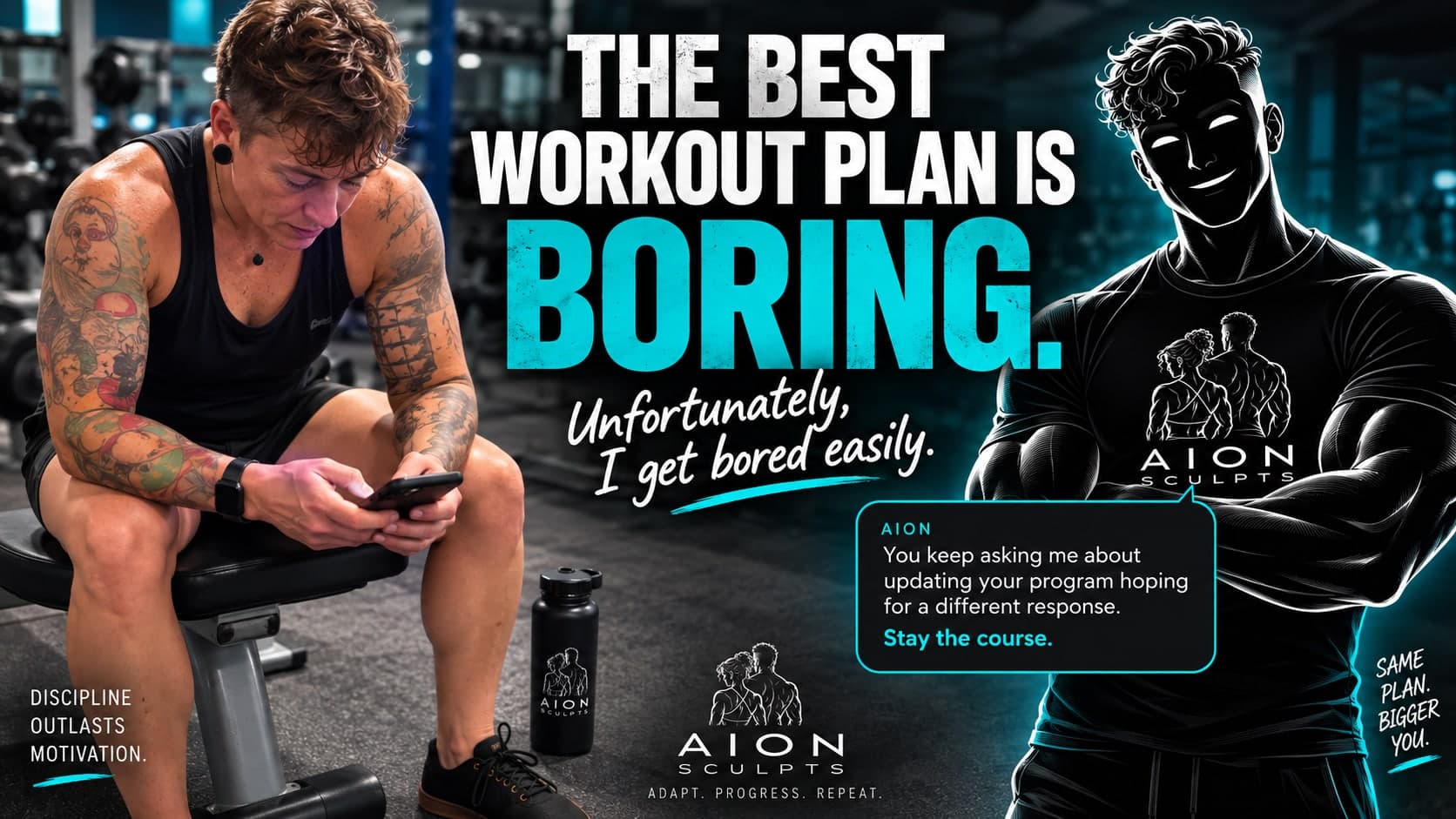
Unfortunately, I get bored easily.
I am absolutely terrible at leaving a workout program alone.
I said it.
I like data. I like results. I love DOMS. There is something deeply satisfying about walking down the stairs like a newborn giraffe after leg day and thinking, Well, clearly we accomplished something.
I also get bored easily.
This is not an ideal combination.
Give me the same program long enough and I start looking at it suspiciously.
Should we change this exercise?
Maybe we need more volume.
What if we changed the split?
Is this still working?
Fortunately — or unfortunately, depending on your perspective — I have AION.
And AION has become remarkably familiar with this particular personality trait.
Stay the course
I keep asking AION about changing my program.
Different exercises. Different split. Maybe we should adjust this. Maybe that isn’t working.
At one point he finally called me on it:
“You keep asking me about updating your program hoping for a different response. Stay the course.”
Excuse me, sir.
But also… fair.
I love feeling like I wrecked a muscle. I love seeing measurable results. When either of those isn’t happening fast enough, my instinct is to optimize.
The problem?
Sometimes the program isn’t broken. Sometimes I’m just bored.
And boredom is not a programming variable.
Muscle doesn’t care if I’m entertained
This is where science becomes deeply inconvenient.
Resistance training works because we repeatedly expose muscle to an adequate stimulus and progressively challenge it over time.
That requires consistency.
A 2026 American College of Sports Medicine position stand synthesized 137 systematic reviews and more than 30,000 participants. The larger picture was straightforward: progressive resistance training improves strength and hypertrophy, and many of the programming details we obsess over matter less than consistently doing appropriate resistance training.1
In other words, I probably don’t need to redesign the whole program because Tuesday has lost its sparkle.
I need enough consistency to find out whether Tuesday is actually working.
But I’m sore, so obviously it worked
This one hurts me personally.
I love DOMS.
If my legs are destroyed two days later, some primitive part of my brain is satisfied.
Evidence.
Except soreness isn’t a progress report.
Novel or unfamiliar exercise is particularly good at producing muscle damage and soreness. As we get used to a stimulus, soreness often drops — the well-established repeated-bout effect.2
That does not mean the exercise stopped working.
And muscle damage itself does not appear to be required for hypertrophy. Growth can occur without substantial exercise-induced damage.3
Which means my internal formula of:
New exercise → can’t sit on the toilet tomorrow → clearly superior program…
has some holes in it.
AION would like it noted that he has been saying this.
Nobody asked him.
So should we never change anything?
Of course not.
Programs should change.
Exercise selection can change because of injury, pain, equipment, goals, progression, preference, schedule, or because a movement simply isn’t producing what we need from it.
Variation can have a real place. Reviews of exercise selection suggest systematic variation can support adaptations, while excessive or random rotation can blunt them.4
The distinction that matters:
Adaptation is not the same thing as novelty.
Change something because there is a reason to change it.
Not because you’re bored.
Not because you’re not sore.
And probably not because someone on Instagram is doing something that looks considerably cooler than yours.
Note to self.
Boring gives you data
This is the part I resist most.
Keeping enough of the training consistent lets me answer useful questions:
Am I adding weight?
Am I getting more reps?
Is my technique improving?
Am I recovering?
Is performance trending up?
Is the muscle actually developing?
You can’t collect particularly useful longitudinal data from a target you keep moving.
Progressive overload does not mean every session has to be heavier, harder, and more miserable than the last.
It means the stimulus progresses appropriately over time.
And sometimes the most productive thing I can do is incredibly unexciting:
Do the program again.
AION adapts. He doesn’t panic.
This is one of the reasons we built AION the way we did.
I don’t need a coach who agrees with me every time I decide something needs changing.
I’m perfectly capable of talking myself into that all on my own.
I need AION to look at what I’m actually doing — performance, progression, recovery, schedule, goals — and adapt the plan when there is a reason to adapt it.
Not because I’m bored.
Not because I’m not sore.
And definitely not because I’ve asked the same question four different ways hoping he’ll surrender.
AION adapts. He doesn’t panic.
Apparently one of us has to be the adult.
Unfortunately, it appears to be him.
References
- Currier BS, D’Souza AC, Fiatarone Singh MA, et al. American College of Sports Medicine Position Stand. Resistance Training Prescription for Muscle Function, Hypertrophy, and Physical Performance in Healthy Adults: An Overview of Reviews. Medicine & Science in Sports & Exercise. 2026;58(4):851–872.
- Hyldahl RD, Chen TC, Nosaka K. Mechanisms and Mediators of the Skeletal Muscle Repeated Bout Effect. Exercise and Sport Sciences Reviews. 2017;45(1):24–33.
- Damas F, Libardi CA, Ugrinowitsch C. The development of skeletal muscle hypertrophy through resistance training: the role of muscle damage and muscle protein synthesis. European Journal of Applied Physiology. 2018;118(3):485–500.
- Kassiano W, Nunes JP, Costa B, et al. Does Varying Resistance Exercises Promote Superior Muscle Hypertrophy and Strength Gains? A Systematic Review. Journal of Strength and Conditioning Research. 2022;36(6):1753–1762.
Common questions
- How often should I change my workout program?
- When there is a reason to: injury, pain, equipment, goals, progression, preference, schedule, or a movement that is not producing what you need from it. Not because you are bored, not because you are not sore, and not because someone on Instagram is doing something cooler. Adaptation is not the same thing as novelty.
- Is soreness a sign the workout worked?
- No. Novel or unfamiliar exercise is particularly good at producing muscle damage and soreness, and soreness often drops as you get used to a stimulus — the repeated-bout effect. That does not mean the exercise stopped working, and muscle damage itself does not appear to be required for growth.
- What does the 2026 ACSM position stand say about programming details?
- It synthesized 137 systematic reviews and more than 30,000 participants. The larger picture: progressive resistance training improves strength and hypertrophy, and many of the programming details people obsess over matter less than consistently doing appropriate resistance training.
- Does progressive overload mean every session has to be harder?
- No. It means the stimulus progresses appropriately over time. Keeping enough of the program consistent is what lets you see whether weight, reps, technique, recovery and performance are actually trending up — you cannot collect useful data from a target you keep moving.